Uncategorized
What Is AI Search Visibility and Why Does It Matter for Businesses?
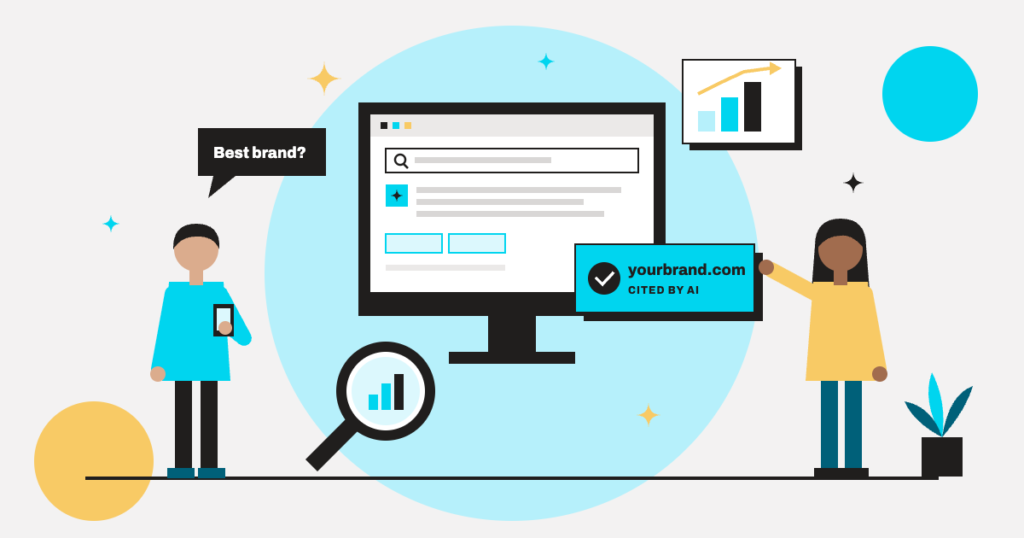
AI search visibility is how often, how accurately and how favorably your brand appears in answers written by AI tools such as Google AI Overviews, Google AI Mode, ChatGPT, Perplexity, Gemini and Microsoft Copilot. It covers three outcomes: being named, being cited as a source, and being recommended.
It matters because buyers now ask these tools for shortlists before they visit a website. About half of U.S. adults use AI chatbots, and 42% use them to search for information, according to a 2026 Pew Research Center survey. If the answer names three competitors and not you, you can lose the deal before anyone sees your site.
Here is what that looks like. An operations manager asks ChatGPT, “What’s the best payroll software for a 40-person accounting firm?” The answer names four vendors, explains who each one suits, and links to two review sites. Your product ranks second on Google for “payroll software for small business,” yet it is not in the answer. On that question, for that buyer, you are invisible.
This guide explains what AI search visibility includes, how each AI platform chooses what to show, how to measure it with 10 metrics and real formulas, how to run your own check, and what tends to improve it. It also introduces a framework for linking visibility to revenue and a 30-day experiment you can run yourself.
Key takeaways
- AI search visibility has three layers. A mention names you, a citation links to you as a source, and a recommendation advises the buyer to choose you. Track them separately.
- AI tools are now a mainstream research channel. 49% of U.S. adults use AI chatbots and 60% say they read AI summaries in search results (Pew, 2026).
- Ranking well no longer guarantees inclusion. Only 38% of pages cited in AI Overviews also ranked in the top 10 for the same query, down from about 76% in mid-2025 (Ahrefs, 2026).
- AI answers are unstable, so single checks mislead. Ask for brand recommendations twice and there is under a 1-in-100 chance of getting the same list (SparkToro, 2026). Measure how often you appear across many runs, not your “position.”
- Branded and unbranded results tell different stories. In one vendor’s data, the median brand appeared in 93% of answers that named it but only 7% of answers to open category questions (Searchable). The unbranded number is the one that reaches new buyers.
- There is no universal “good” score. Benchmark against your own baseline and your direct competitors on the same prompts.
- Visibility is a leading indicator, not revenue. Connect it to referral traffic, branded search, leads and pipeline before you call it a win.
What Is AI Search Visibility?
AI search visibility is your brand’s presence inside AI-generated answers to the questions your customers ask. Traditional search visibility measures where your pages rank in a list of links. AI visibility measures whether you are part of the answer itself, and how you are described when you are.
Two terms do a lot of work here. A prompt is the question a person types into an AI tool. A generative engine is any system that writes an answer from multiple sources rather than returning a ranked list.
Mentions, citations and recommendations are not the same thing
These three outcomes are often lumped together. They have different value.
| Outcome | What it looks like | Example | Why it matters |
|---|---|---|---|
| Mention | Your brand is named in the answer, with or without a link | “Options include Paylark, Tallyfox and Acme Payroll.” | Builds awareness and puts you on the shortlist |
| Citation | Your page is linked as a source behind the answer | A footnote link to your pricing guide | Signals the AI used your content; can send traffic |
| Recommendation | The answer advises choosing you for a stated need | “For firms under 50 people, Acme Payroll is the strongest fit.” | Closest to a buying decision |
A brand can be cited without being recommended. For example, an AI tool may quote your blog post’s definition while recommending a competitor’s product. It can also be recommended without being cited, when the model draws on reviews or third-party articles instead of your own pages.
A citation is also not an endorsement. AI tools cite pages they found useful for building the answer, and that can include a page that criticizes you.
What counts as AI visibility
- Brand mentions in a generated answer
- Source citations that link to your domain
- Recommendations for a specific use case or buyer
- Product inclusion in AI shopping results or product comparisons
- AI-generated comparisons where you appear next to competitors
- Accurate descriptions of what you sell, who you serve and what you cost
How Does AI Search Visibility Work?
Most AI search tools follow the same broad pattern. They interpret the question, gather sources, write an answer, and then decide what to credit. The details differ by platform, and much of the ranking logic is not public.
The four steps behind an AI answer
- Interpretation. The system works out what is being asked. Google says AI Overviews and AI Mode may use “query fan-out,” running several related searches across subtopics to build one response (Google Search Central).
- Retrieval. The system pulls candidate content, usually from a search index. This is often called retrieval-augmented generation (RAG): the model looks things up before it writes. Some answers skip retrieval and come only from what the model learned in training.
- Synthesis. A large language model writes the answer from the retrieved passages. It chooses which brands to name, in what order, and with what framing.
- Attribution. The system decides which sources to show as links. Not every source used is shown, and not every answer shows sources.
Fan-out explains why a page that ranks first for the exact question can still be skipped. The answer may be assembled from pages that rank for related sub-questions instead. That is a plausible explanation for Ahrefs’ finding that 62% of AI Overview citations did not rank in the top 10 for the original query, though Google has not published how it weighs sources.
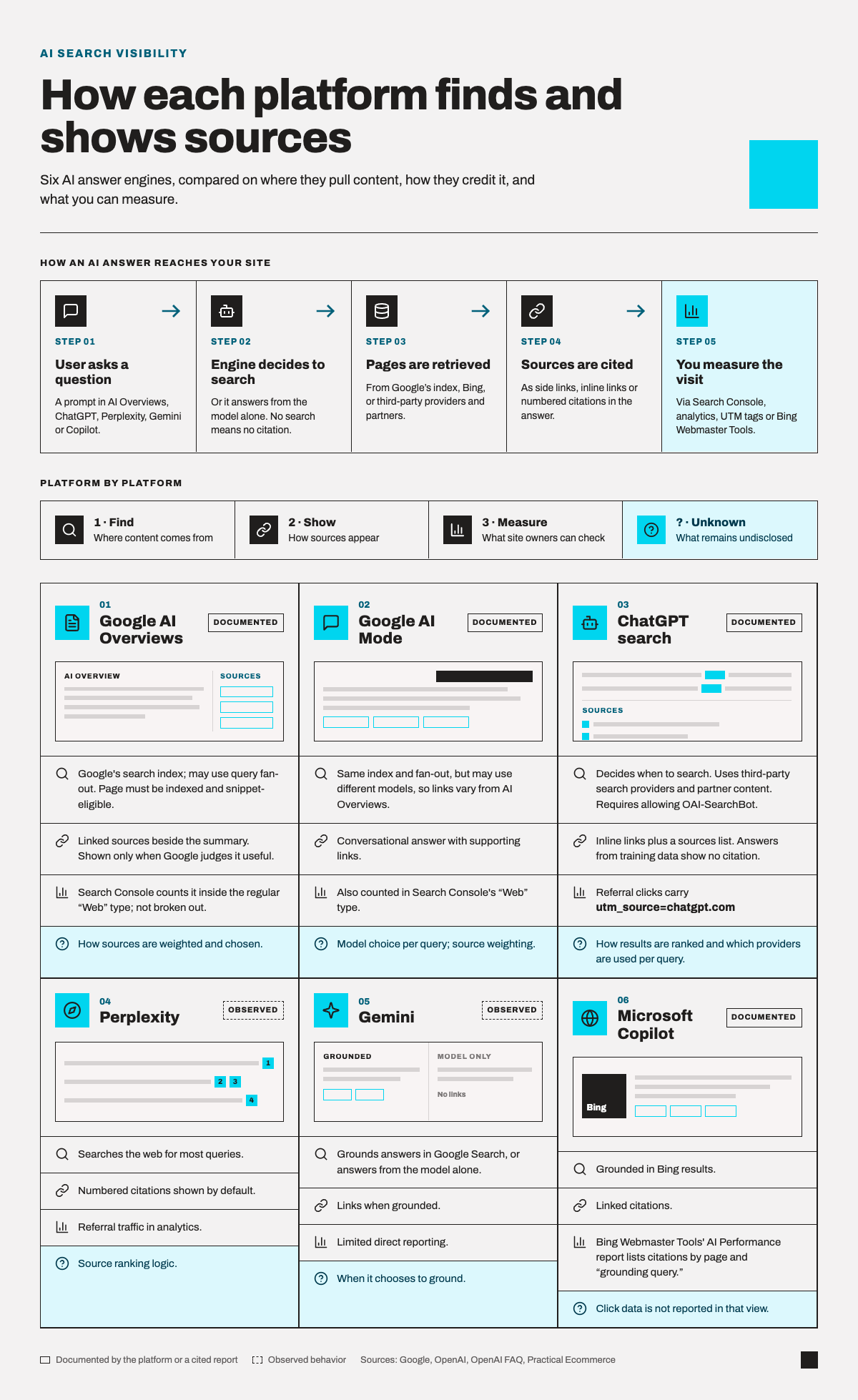
The practical point: each platform retrieves and weighs sources differently, so your visibility will differ by platform. Measure each one separately rather than assuming one result applies everywhere.
Why Does AI Search Visibility Matter for Businesses?
AI search visibility matters because AI tools now shape the shortlist, and the shortlist shapes the sale. The effect shows up in four places: who discovers you, how many clicks reach you, how you are described, and how much of your influence you can actually measure.
Buyers are already asking AI
In February 2026, 49% of U.S. adults said they use AI chatbots, up from 33% in 2024. Searching for information was the most common use, at 42% of adults, and about a quarter used chatbots daily. That comes from a probability-based survey of 5,119 adults by Pew Research Center.
Scale matters too. ChatGPT passed 900 million weekly active users in February 2026, according to figures OpenAI reported (Search Engine Land). That is a company-reported number, not an audited one.
What this means for you: a large share of your buyers can now get a vendor shortlist without opening a search results page. Your brand needs to be in that shortlist.
Fewer clicks reach your website
When Google shows an AI summary, people click less. Pew tracked the real browsing of 900 U.S. adults across 68,879 searches in March 2025. Users clicked a traditional result on 8% of visits with an AI summary, versus 15% without one, and clicked a link inside the summary on just 1% of visits (Pew, July 2025).
Ahrefs found a similar pattern from the publisher side. Across 300,000 keywords, the presence of an AI Overview correlated with a 58% lower click-through rate for the top-ranking page in December 2025, compared with December 2023 (Ahrefs, 2026). That is a correlation drawn from Search Console data, not a controlled test, but it lines up with Pew’s behavioral data.
Google’s position is different. Its documentation says clicks from results pages with AI Overviews are higher quality, meaning visitors spend more time on site (Google Search Central). Both can be true: fewer clicks, better-qualified clicks.
What this means for you: traffic alone will understate your influence. If the answer already persuaded the buyer, being named in it may matter more than the click.
Rankings no longer guarantee inclusion
Ahrefs analyzed 863,000 search results and 4 million AI Overview citations. Only 38% of cited pages also ranked in the top 10 for the same query. In July 2025, the comparable figure was about 76% (Ahrefs, March 2026). Ahrefs suggests that query fan-out, where Google searches related sub-questions, is pulling more sources from outside the original results.
SEO still matters, because AI Overviews draw on Google’s index. But a page-one ranking is now an input, not a guarantee.
How you are described shapes the decision
AI answers do not just list brands. They frame them: “best for startups,” “a budget option,” “popular but expensive.” That framing positions you before a sales conversation starts.
The framing can also be wrong. In SparkToro’s 2026 study, AI tools recommended influencers who were no longer active and businesses that had closed (SparkToro). Outdated pricing, a discontinued product or the wrong target customer can all cost you deals quietly.
What it means by business model
- B2B and SaaS: buyers use AI to build vendor lists, compare features and check integrations before contacting sales. Absence from “best X for Y” prompts removes you from early consideration.
- E-commerce: AI shopping answers compress dozens of options into a handful of product picks. Product data, reviews and comparison content decide who survives that compression.
- Local and professional services: “best family dentist near me” or “top employment lawyer in Denver” answers lean on reviews, listings and third-party profiles, not just your website.
The measurement gap: influence you can’t see in analytics
AI visibility often works without a trackable click. A buyer sees your brand in ChatGPT, then searches your name on Google a day later, or types your URL directly. Analytics records that visit as branded organic or direct traffic, not as AI.
Some vendors report that visitors who do click through from AI tools convert better. Semrush, for example, reported that the average AI search visitor was worth 4.4 times the average traditional organic visitor, based on conversion rate (Semrush). Its method is only partly disclosed, and results vary widely by business, so treat it as directional.
What this means for you: measure AI visibility directly, and pair it with signals that capture indirect influence: branded search volume, direct traffic, and “How did you hear about us?” answers that include AI tools as an option.
AI Search Visibility vs. Traditional SEO
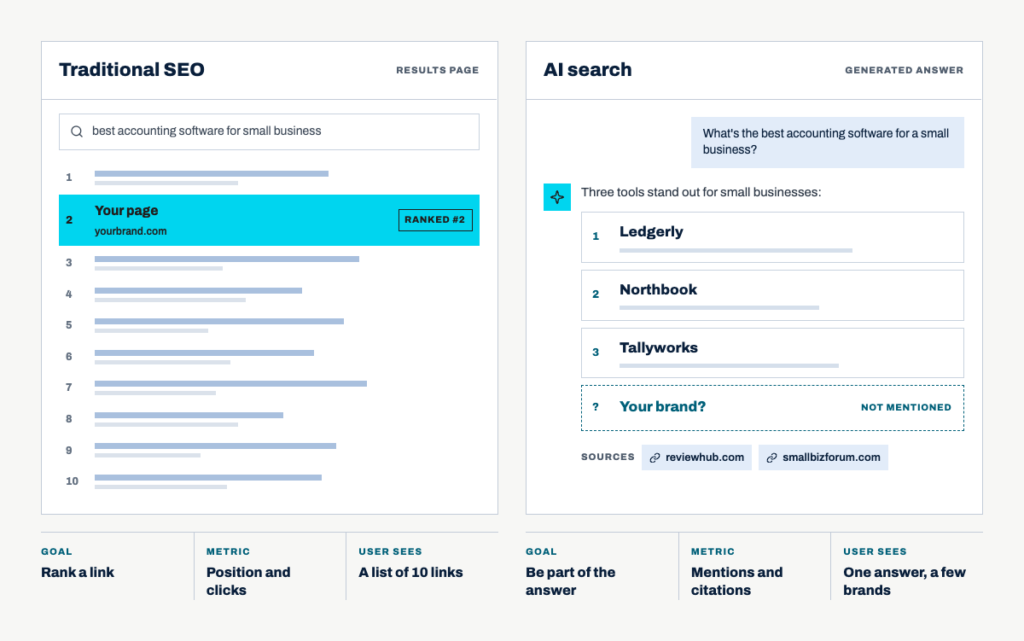
AI search optimization complements SEO; it does not replace it. Google states there are no extra requirements for appearing in AI Overviews or AI Mode beyond normal SEO best practice (Google). But what you optimize toward, and how you measure it, changes.
| Dimension | Traditional SEO | AI search visibility |
|---|---|---|
| Optimization objective | Rank pages high for target keywords | Be named, cited and recommended inside generated answers |
| Visibility metrics | Rankings, impressions, share of search visibility | Mention rate, citation rate, recommendation rate, AI share of voice |
| Search behavior | Short keyword queries | Longer, conversational prompts with context and follow-ups |
| Content discovery | Crawled and ranked page by page | Retrieved passage by passage, often through several sub-queries |
| Ranking vs. recommendation | An ordered list of 10 links | A short answer naming a few brands, framed by use case |
| Citations | Not applicable; the result is the link | Sources may or may not be shown; not every source used is credited |
| Clicks | Main goal of a ranking | Often zero-click; influence can happen without a visit |
| Measurement | Stable, repeatable rank checks | Repeated sampling, because answers change between runs |
| Conversion attribution | Organic channel in analytics | Partial: AI referrals are trackable, but indirect influence shows up as branded or direct traffic |
Why they work together: strong SEO gets your content indexed, crawled and trusted, which AI systems rely on for retrieval. AI visibility work adds what SEO alone does not cover: prompt research, third-party corroboration, answer-ready content and repeated measurement. Hitox runs both as one program through its SEO services and GEO and AEO services.
How Do You Measure AI Search Visibility?
You measure AI search visibility by running a fixed set of buyer prompts across AI platforms many times, recording what each answer says, and calculating rates. No single metric captures it. The 10 below cover presence, competition, quality and business impact.
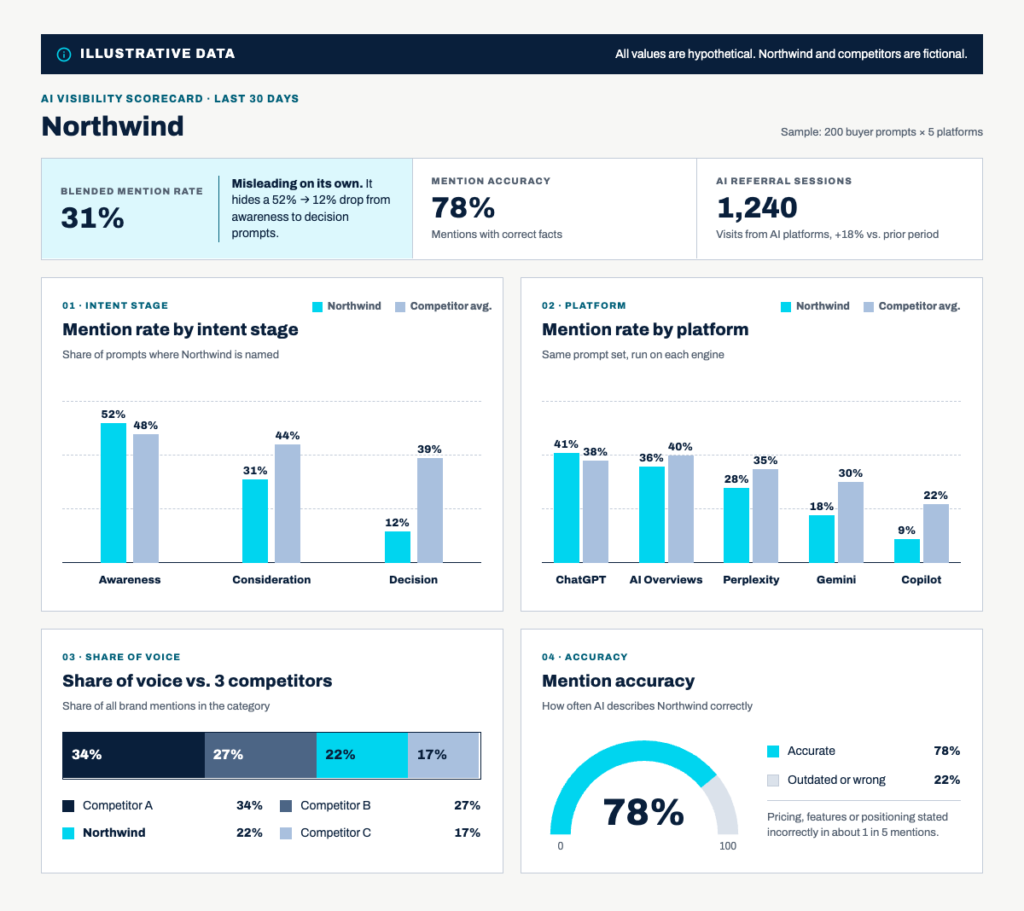
The worked examples use one hypothetical company. “Northwind CRM” (fictional) tracks 40 unbranded prompts on 3 platforms, running each prompt 5 times a month. That gives 600 recorded answers. All numbers are illustrative, not benchmarks.
1. Brand mention rate
- Definition: the share of answers that name your brand.
- Formula: answers mentioning your brand ÷ total answers × 100
- Example: Northwind is named in 132 of 600 answers. 132 ÷ 600 = 22%.
- Interpretation: roughly one in five times a buyer asks these questions, Northwind is in the answer.
- Limitations: a mention can be negative or in passing. It says nothing about how you were described.
2. Citation rate
- Definition: the share of answers that link to your domain as a source, out of answers that show sources at all.
- Formula: answers citing at least one of your URLs ÷ answers that display any citations × 100
- Example: 480 of the 600 answers showed sources. 48 cited a Northwind page. 48 ÷ 480 = 10%.
- Interpretation: AI tools mention Northwind more often than they use its content. Its reputation is being built mostly on other people’s pages.
- Limitations: answers drawn from training data show no sources. Use the right denominator, or the rate looks artificially low.
3. Recommendation rate
- Definition: the share of answers that explicitly advise choosing you for a stated need.
- Formula: answers recommending you ÷ total answers × 100. Also track recommendations ÷ mentions.
- Example: Northwind is recommended in 54 answers. 54 ÷ 600 = 9%. And 54 ÷ 132 mentions = 41% of mentions are recommendations.
- Interpretation: when Northwind appears, it is endorsed less than half the time. Positioning, not just presence, needs work.
- Limitations: “recommended” requires a written rule (for example, “named as best for, top pick, or first choice”). Without one, two people will score it differently.
4. Share of voice
- Definition: your share of all brand mentions across your competitive set, on the same prompts.
- Formula: your mentions ÷ total mentions of all tracked brands × 100
- Example: Northwind 132, Competitor A 260, Competitor B 190, Competitor C 118. Total 700. 132 ÷ 700 = 18.9%.
- Interpretation: Competitor A holds more than a third of the conversation (260 ÷ 700 = 37%). Northwind is third of four.
- Limitations: depends entirely on which competitors you include. Change the set and the number changes.
5. Unbranded discovery rate
- Definition: the share of unbranded prompts (ones that don’t name you) where you appear reliably.
- Formula: unbranded prompts where you appear in at least 3 of 5 runs ÷ total unbranded prompts × 100
- Example: Northwind appears at least once on 14 of 40 prompts, but in 3+ of 5 runs on only 8. 8 ÷ 40 = 20%.
- Interpretation: Northwind owns a fifth of its category questions. The other 6 prompts where it shows up occasionally are the nearest opportunities.
- Limitations: the threshold (3 of 5) is a choice. Keep it fixed so results stay comparable.
6. Competitive inclusion rate
- Definition: when the AI names a competitor, how often it also names you.
- Formula: answers naming you and at least one tracked competitor ÷ answers naming at least one tracked competitor × 100
- Example: competitors appear in 520 answers. Northwind appears in 110 of those. 110 ÷ 520 = 21%.
- Interpretation: in four out of five shortlists that include a rival, Northwind is missing from the comparison.
- Limitations: does not show whether you were framed better or worse than the competitor.
7. Mention accuracy
- Definition: how correctly the AI describes you when it mentions you.
- Formula: accuracy points earned ÷ points possible × 100, using the rubric below on a sample of mentions.
- Rubric (0 = wrong, 1 = partly right or vague, 2 = correct): category, core features, pricing or plan, and ideal customer. Maximum 8 points per mention.
- Example: 50 mentions scored, 400 points possible, 296 earned. 296 ÷ 400 = 74%. Six mentions scored 0 on pricing, citing a plan retired last year.
- Interpretation: the AI knows what Northwind is but repeats outdated pricing. That points to stale third-party pages.
- Limitations: manual scoring takes time. Score a sample, and have a second person check 10% of it.
8. Sentiment and positioning
- Definition: whether mentions are favorable, and what role the answer gives you.
- Formula: net sentiment = (positive − negative mentions) ÷ scored mentions × 100. Record positioning labels separately.
- Example: of 50 mentions, 28 positive, 18 neutral, 4 negative. (28 − 4) ÷ 50 = +48. Most common label: “good for small teams”; the target was “best for agencies.”
- Interpretation: the tone is fine, but the AI places Northwind in the wrong segment.
- Limitations: tone and positioning are judgment calls. Write definitions down before scoring.
9. AI referral traffic
- Definition: sessions arriving on your site from AI platforms.
- Formula: sessions from AI referrers ÷ total sessions × 100. In GA4, filter session source with a pattern such as chatgpt.com|perplexity.ai|gemini.google.com|copilot.microsoft.com|claude.ai.
- Example: 1,240 AI-referred sessions out of 86,000 total in a quarter. 1,240 ÷ 86,000 = 1.4%.
- Interpretation: small in volume. Judge it by what those visitors do, not how many arrive.
- Limitations: clicks from Google AI Overviews and AI Mode count as normal Google organic. Some apps strip referrer data, so AI traffic can be logged as direct.
10. AI-assisted conversions
- Definition: conversions where an AI touchpoint is recorded, either as a referral or in what the buyer reports.
- Formula: conversions with an AI referral or an AI answer to “How did you hear about us?” ÷ total conversions × 100
- Example: 31 conversions came from AI referrals in a quarter, and 19 more buyers selected “ChatGPT or another AI tool” on the form. 50 ÷ 600 conversions = 8.3%. The AI referral conversion rate was 31 ÷ 1,240 = 2.5%, against 1.1% for organic.
- Interpretation: AI drives more business than its traffic share suggests. That supports investing in visibility, not just clicks.
- Limitations: self-reporting is imperfect and depends on form design. Treat it as a floor, not a total.
Why one overall visibility score can mislead
Many tools roll everything into one number. That hides the information you need to act.
- Branded and unbranded prompts behave differently. In Searchable’s data on 3,627 brands, the median brand was named in 93% of branded-prompt answers but 7% of unbranded ones (Searchable). Blend them and you look far more visible to new buyers than you are.
- Platforms disagree. You can be strong in Perplexity and absent in ChatGPT. An average hides which channel needs work.
- Intent stages differ. Being visible on “what is” prompts does not mean you are visible on “best tool for” prompts, which are closer to purchase.
How many runs you need: a rule of thumb
AI answers change between runs, so treat each measurement like a poll. The margin of error for a rate is roughly:
MOE \approx 1.96 \sqrt{\frac{p(1-p)}{n}}
Here p is your measured rate and n is the number of answers. At a 20% mention rate:
| Answers recorded (n) | Approximate margin of error |
|---|---|
| 50 | ±11 points |
| 200 | ±5.5 points |
| 600 | ±3.2 points |
So a move from 18% to 22% on 50 answers is noise. On 600 answers, it may be real. Runs of the same prompt are related to each other, so treat these margins as the minimum uncertainty, not the exact figure.
Other things that distort results:
- Prompt selection bias: prompts you wrote yourself tend to favor terms you already rank for.
- Personalization: logged-in history and memory can change answers. Use clean sessions where possible.
- Location and language: answers vary by country and city, especially for local queries.
- Model updates: platforms change models without notice. Note dates and any visible model changes in your log.
- API vs. app differences: answers pulled through developer APIs may differ from what users see in the app. SparkToro flagged this as an open question (SparkToro).
What Is a Good AI Search Visibility Score?
There is no universally accepted benchmark for a good AI visibility score. Category size changes everything: in SparkToro’s research, a narrow category like cloud providers for startups produced far more consistent brand lists than a broad one like new science-fiction novels. A 30% mention rate can be dominant in one market and weak in another.
SE Ranking makes the same point: the most useful benchmark is your closest competitors (SE Ranking). Compare yourself on five axes:
- Your own historical baseline (are you improving?)
- Direct competitors on the same prompts
- Branded vs. unbranded prompts
- Each AI platform separately
- Each buyer-intent stage (learn, compare, choose)
Illustrative scorecard (hypothetical data, not an industry standard). Mention rate by segment for Northwind CRM:
| Segment | Northwind now | Northwind 3 months ago | Competitor A | Competitor B |
|---|---|---|---|---|
| Branded prompts, all platforms | 91% | 88% | n/a | n/a |
| Unbranded “learn” prompts | 30% | 26% | 41% | 22% |
| Unbranded “compare” prompts | 18% | 11% | 47% | 30% |
| Unbranded “choose” prompts | 12% | 12% | 52% | 25% |
| ChatGPT (unbranded) | 25% | 19% | 44% | 28% |
| Google AI Overviews (unbranded) | 14% | 13% | 49% | 21% |
| Perplexity (unbranded) | 21% | 17% | 47% | 29% |
How to read it: Northwind is improving on comparison prompts, but it is flat on “choose” prompts, where buyers decide, and weakest in Google AI Overviews. That tells the team exactly where to focus. A single blended score of about 30% would have hidden all of it.
How to Check Your AI Search Visibility
You can run a useful first check in a spreadsheet, without paid tools. Plan on a day to set up and a few hours each month to repeat.
- Identify customer questions. Pull them from sales calls, support tickets, demo requests, reviews and community threads. Use the buyer’s wording, not your marketing language.
- Create a representative prompt library. Aim for 30–50 prompts. Include “learn” prompts (“how do I…”), “compare” prompts (“X vs Y,” “alternatives to X”) and “choose” prompts (“best X for Y”).
- Separate branded and unbranded prompts. Keep a small branded set (“What is Northwind CRM?”, “Is Northwind good for agencies?”) to test accuracy. Make most prompts unbranded to test discovery.
- Prioritize prompts by value. Score each prompt 1–3 on commercial intent, on how often sales hears it, and on fit with your best customers. Multiply the three scores (maximum 27). Track your highest scorers first.
- Select the AI platforms your buyers use. Two or three platforms measured well beat seven measured badly. Ask customers which ones they use.
- Run each prompt multiple times. Use at least 3–5 runs per prompt per platform per cycle, in clean sessions, from the market you sell into.
- Record mentions and citations. For each answer, log whether you were mentioned, recommended and cited, plus the cited URLs.
- Identify competing brands. Log every brand named. Your real competitive set in AI may differ from the one in your sales deck.
- Analyze cited sources. List which domains appear most often. These are the review sites, publications and communities that shape answers in your category.
- Establish a baseline, then repeat consistently. Calculate your rates, save the raw answers, and rerun the same prompts on the same schedule. When you change the prompt set, start a new baseline.
Worked example (hypothetical). Northwind ran prompt P07 five times on ChatGPT and was mentioned in 2 of 5 runs, recommended in 0, and cited in 0. Competitor A appeared in all 5. On Perplexity, Northwind was mentioned in 4 of 5 and cited in 3, always to its agency landing page. The difference suggests its agency page is retrievable when the platform searches, while ChatGPT’s answers lean on review sites where Northwind is thinly covered. The next action is a source fix, not a new blog post.
How to Improve AI Search Visibility
You improve AI search visibility by making your content easy to retrieve, easy to quote and easy to verify elsewhere. No single tactic guarantees a citation or a recommendation, because AI answers are probabilistic. The actions below raise the odds, and each one targets a specific part of the problem.
Research supports the direction, with limits. A peer-reviewed study that introduced the term GEO found that content changes such as adding statistics and quotations raised visibility in generative engine responses by up to 40% on its test benchmark (Aggarwal et al., KDD 2024). Results varied by subject area, and benchmark engines are not identical to commercial ones.
| # | Action | What to do | What it is meant to improve |
|---|---|---|---|
| 1 | Technical accessibility and crawlability | Allow Googlebot, Bingbot and OAI-SearchBot in robots.txt and at your CDN. Keep key pages indexable and snippet-eligible. Put important facts in HTML text, not images or PDFs | Eligibility to be retrieved at all. A vendor study of 1,000 domains found 12.2% blocked at least one major AI crawler (Mustard Seed) |
| 2 | Clear service and product descriptions | State what you sell, who it is for, where you operate and what it costs, in plain sentences near the top of key pages | Mention accuracy and correct positioning |
| 3 | Helpful, factual, structured content | Lead each section with a direct answer, then support it. Use descriptive headings and tables for comparisons | Passage retrieval and accurate quoting |
| 4 | Relevant structured data | Add Organization, Product, LocalBusiness or Article markup that matches visible text. Google says no special schema is needed for its AI features (Google) | Clear entity facts for search systems; not a guaranteed citation |
| 5 | Author and company credibility | Named authors with bios and credentials; an About page with real people, history and contact details | Trust signals for sources that make claims |
| 6 | Original research | Publish data others will cite: surveys, benchmarks, pricing studies | Citations from your pages and mentions on others’ pages |
| 7 | Expert commentary | Add quotes and specific judgment from named practitioners | Depth and quotability |
| 8 | Independent third-party mentions | Earn coverage on the review sites, publications and communities AI tools cite in your category | Recommendation rate. AI answers draw heavily on pages you don’t own |
| 9 | Digital PR | Pitch data and expert views to the outlets that appear in your cited-sources list | Mentions on high-trust sources |
| 10 | Relevant industry directories | Keep complete profiles on G2, Capterra, Clutch, Google Business Profile, Bing Places or your industry’s equivalents | Corroboration and local inclusion |
| 11 | Product and business data consistency | Match names, prices, features, addresses and hours across your site, feeds, listings and profiles. Google recommends keeping Merchant Center and Business Profile data current | Accuracy; fewer contradictory facts |
| 12 | Comparison and use-case content | Publish honest “X vs Y,” “alternatives to,” and “best for [use case]” pages | Inclusion on compare and choose prompts |
| 13 | FAQ content | Answer real buyer questions in self-contained 40–80 word answers | Direct-answer extraction |
| 14 | Internal linking | Link from high-authority pages to the pages you want cited | Discovery and crawl priority |
| 15 | Content freshness | Show “last updated” dates, and actually update numbers, prices and screenshots | Selection on time-sensitive prompts; accuracy |
| 16 | Measurement and iteration | Rerun your prompt set monthly, review cited sources, and fix the gaps they reveal | Knowing which actions moved results |
Third-party platforms deserve special attention. Ahrefs reports that YouTube is the most-cited domain in AI Overviews in its dataset, and that 18% of AI Overview citations that did not rank in the top 100 came from YouTube (Ahrefs). Community platforms such as Reddit also appear often in AI answers. Genuine participation helps; fake seeding is risky and tends to backfire.
Common AI Search Visibility Mistakes
- Tracking only branded prompts. AI tools usually know who you are when asked by name. The real test is whether they suggest you to buyers who haven’t heard of you.
- Checking a prompt once. One answer is a snapshot. With answers this variable, a single check can be wrong in either direction.
- Confusing mentions with citations. Being named and being used as a source are different results with different fixes.
- Treating citations as endorsements. An AI tool can cite your page while recommending a competitor.
- Ignoring recommendation accuracy. Being mentioned with the wrong price or the wrong audience can hurt more than being absent.
- Assuming a high Google ranking guarantees AI visibility. Most AI Overview citations in Ahrefs’ 2026 data did not rank in the top 10 for the same query.
- Using unsupported schema claims. Structured data helps systems understand facts. It does not guarantee AI citations, and it must match what is visible on the page.
- Publishing large quantities of low-value content. Mass-produced pages add little that AI tools can’t already say, and they can weaken trust signals.
- Ignoring third-party sources. Much of what AI says about you comes from reviews, directories, forums and articles you don’t control.
- Failing to connect visibility to business metrics. Mention rate is a leading indicator. Report it next to referral traffic, branded search and pipeline.
AI Search Visibility for Different Industries
The right prompts and metrics depend on how your customers buy.
| Industry | Realistic buyer prompts | What to measure first | Watch out for |
|---|---|---|---|
| SaaS (GEO for SaaS) | “Best project management tool for a 15-person remote agency” · “Alternatives to [competitor] with better reporting” | Unbranded discovery and competitive inclusion on compare and choose prompts | Outdated pricing tiers and missing integrations in answers |
| E-commerce (GEO for e-commerce) | “Best trail running shoes for wide feet under $150” · “Is [brand] worth it for marathon training?” | Product inclusion rate and recommendation rate by product line | Wrong prices, out-of-stock items, and review-site framing |
| Professional services | “Top bookkeeping firms for e-commerce businesses in Toronto” · “How to choose an employment lawyer in Manchester” | Mention rate in location-specific prompts; accuracy of services listed | Directory profiles that list services you no longer offer |
| Healthcare (GEO for healthcare) | “Best physical therapy clinics for sports injuries in Austin” · “What should I ask before choosing a dermatologist?” | Accuracy and sentiment, then inclusion | Higher scrutiny of health information; clinical claims need expert review |
| Real estate (GEO for real estate) | “Best neighborhoods in Melbourne for young families” · “Top buyer’s agents in Scottsdale” | Citation rate for neighborhood and market guides; agent mentions | Stale market data and listings |
| Local businesses | “Best family dentist near Brooklyn Heights open Saturdays” · “Emergency plumber in Leeds with good reviews” | Mention rate by location, plus accuracy of hours, address and services | Inconsistent listings across Google Business Profile, Bing Places and directories |
Frequently Asked Questions
Why does AI visibility matter?
AI visibility matters because buyers now use AI tools to research and shortlist options. About half of U.S. adults use AI chatbots, and 42% use them to search for information (Pew, 2026). If AI answers leave you out or describe you wrongly, you can lose buyers before they reach your website.
What is the 30% rule for AI?
There is no standardized “30% rule” for AI search visibility. In business writing, the phrase usually refers to an informal AI-adoption heuristic, most often that AI should handle routine work while people keep roughly 30% of a task for judgment and oversight. Versions conflict, some reverse the split, and no researcher or standards body defines it. It is not a visibility metric or benchmark.
How to boost AI search visibility?
Make sure AI crawlers can reach your site, state key facts clearly in HTML text, and structure pages with direct answers and comparisons. Then earn mentions on the review sites, publications and communities AI tools cite in your category, and keep business data consistent everywhere. Measure monthly and fix the gaps the cited sources reveal.
What is a good search visibility score?
There is no universal good score. In traditional SEO tools, visibility is a weighted estimate of rankings, and 100% is unrealistic. For AI visibility, a good score is one that beats your direct competitors on the same prompts and improves on your own baseline. Compare by platform, intent stage, and branded versus unbranded prompts.
Can you track AI search visibility for free?
Yes. A spreadsheet, a fixed prompt list and manual runs in each AI tool will give you a usable baseline. Add GA4 referral tracking, Google Search Console and Bing Webmaster Tools’ free AI Performance report. Paid tools mainly save time at scale.
Is AI search visibility the same as GEO?
No. AI search visibility is the outcome you measure. Generative engine optimization (GEO) is the practice of improving it. Answer engine optimization (AEO) is a closely related term focused on getting content extracted as direct answers.
Does SEO still matter for AI search?
Yes. Google says the same SEO best practices apply to AI Overviews and AI Mode, with no extra requirements (Google). Indexing, crawlability and helpful content are still the foundation. AI visibility adds third-party corroboration and repeated measurement on top.
How long does improving AI visibility take?
Technical fixes and page updates can show up within weeks, once pages are recrawled. Building third-party mentions and authority usually takes months. Results vary by platform, category competition and how often systems refresh their sources, so expect a quarter before judging a program.
Can Google Analytics track AI search visibility?
Partly. GA4 can track visits referred by ChatGPT, Perplexity, Gemini and Copilot; ChatGPT adds utm_source=chatgpt.com to referral links (OpenAI). It cannot see mentions that produced no click, and Google AI Overview clicks are counted as ordinary Google organic traffic.
Can a website rank on Google but remain absent from ChatGPT?
Yes. ChatGPT search uses its own retrieval through third-party providers and partner content, and requires OAI-SearchBot access. It also weighs reviews and third-party pages. A page-one Google ranking does not guarantee inclusion in ChatGPT answers.
Does structured data guarantee AI visibility?
No. Structured data helps systems understand facts like your organization, products and prices. Google states that no special schema is needed for its AI features. Use markup that matches your visible content, but don’t expect it to produce citations on its own.
How often should AI visibility be measured?
Monthly works for most businesses, with several runs per prompt each time. Measure weekly during an active experiment or a launch. Whatever the cadence, keep the prompts, platforms and settings fixed so the numbers stay comparable.
AI search visibility is becoming part of how buyers form a shortlist, often before any click. The businesses that benefit will be the ones that measure it honestly: by platform, by intent, across many runs, and alongside the revenue signals that prove it matters.
Start with what you can control this month. Check that AI crawlers can reach you. Fix outdated facts about your business wherever they appear. Build a prompt library from real buyer questions, and set a baseline before you change anything.
If you’d like a second set of eyes, Hitox can run an AI visibility baseline across ChatGPT, Perplexity, Gemini and Google AI Overviews, show where competitors are winning the answer, and map the gaps to your pipeline. Explore Hitox’s GEO and AEO services or book a strategy call.
Sources
- Pew Research Center, Americans and AI 2026, June 17, 2026
- Pew Research Center, Google users are less likely to click on links when an AI summary appears, July 22, 2025
- Google Search Central, AI features and your website, updated December 10, 2025
- OpenAI, Introducing ChatGPT search and Publishers and developers FAQ
- Ahrefs, 38% of AI Overview citations pull from the top 10, March 2, 2026
- Ahrefs, AI Overviews reduce clicks by 58%, February 2026
- SparkToro, AIs are highly inconsistent when recommending brands, January 27, 2026
- Searchable, AI visibility tracking, April 8, 2026
- Semrush, AI search and SEO traffic study
- SE Ranking, AI and classic search visibility, March 26, 2026
- Mustard Seed Solutions, AI visibility guide, August 2026
- Aggarwal et al., GEO: Generative Engine Optimization, KDD 2024
- Practical Ecommerce, Bing’s AI Performance report gets better, 2026
- Search Engine Land, ChatGPT and OpenAI statistics, 2026