Uncategorized
How to Beat a Large Company at SEO
Key takeaways
- Don’t fight on their terms. Big companies win broad head terms like “running shoes” or “CRM”. Small brands win the specific, high-intent searches big brands ignore.
- Niche depth beats broad authority. Owning one topic completely (every question, comparison and use case) can outrank a domain with far more total backlinks.
- Speed is your unfair advantage. A big company needs weeks of approvals to publish a page. You can publish, test and update in days.
- First-hand experience is hard to copy. Original data, real photos, founder expertise and case studies are what Google’s helpful-content and E-E-A-T guidelines reward, and what AI engines quote.
- AI search reshuffles the board. ChatGPT, Gemini and Perplexity recommend brands that are mentioned in Reddit threads, reviews and comparison articles, not only brands with the biggest websites.
- Measure share of answer, not just rankings. Track which brands AI recommends for your category’s buying questions, then close the gaps.
Can a small business really beat a big company at SEO?
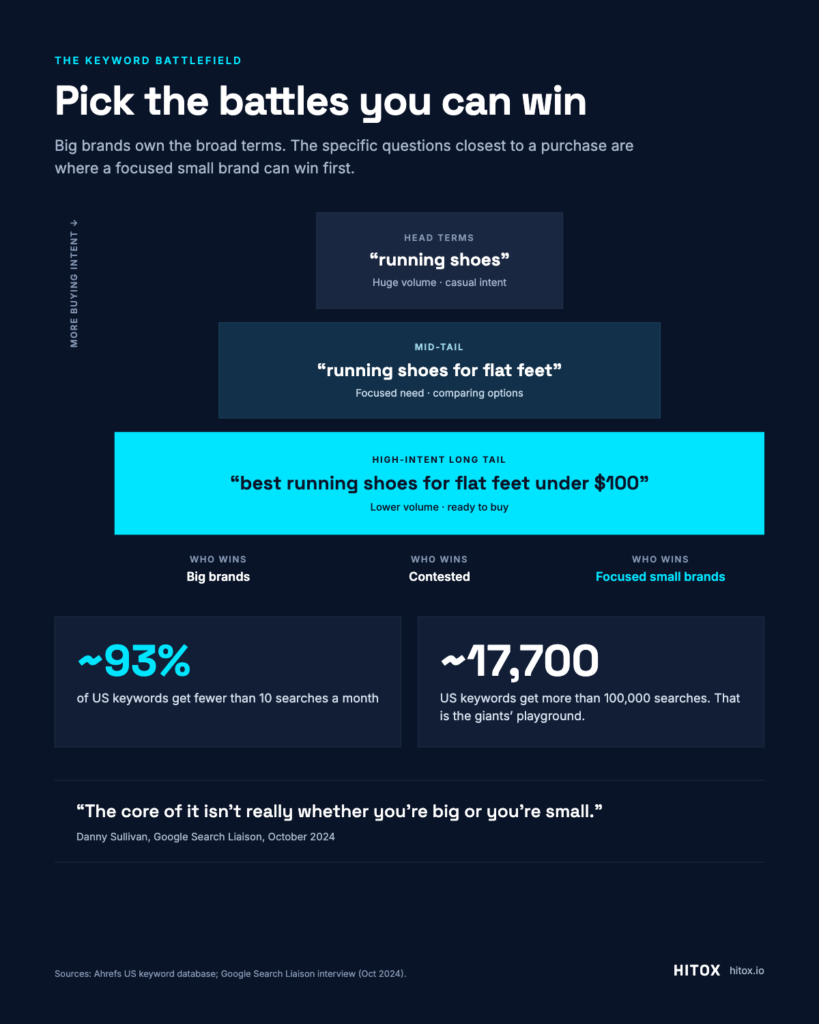
Yes, but not everywhere. A small business rarely outranks Amazon for “running shoes”. It can absolutely outrank Amazon for “best running shoes for flat feet under $100”, and that searcher is far closer to buying.
Big companies have money, backlinks and brand recognition. They also have slow approvals, generic content and thousands of pages nobody maintains. Your job is to pick the battles where their size works against them.
This guide shows where big brands are weak, a step-by-step playbook to beat them, and why AI search (ChatGPT, Gemini, Perplexity, Google AI Overviews) gives smaller brands a new opening that most competitors haven’t noticed yet.
Why big companies are beatable in SEO
Big sites do start with an advantage. Kevin Indig’s analysis of 2,000 sites that won or lost visibility found larger sites had the edge. But that edge is concentrated in broad, high-volume keywords, and most searches aren’t broad.
Most searches are long-tail, where big brands don’t bother
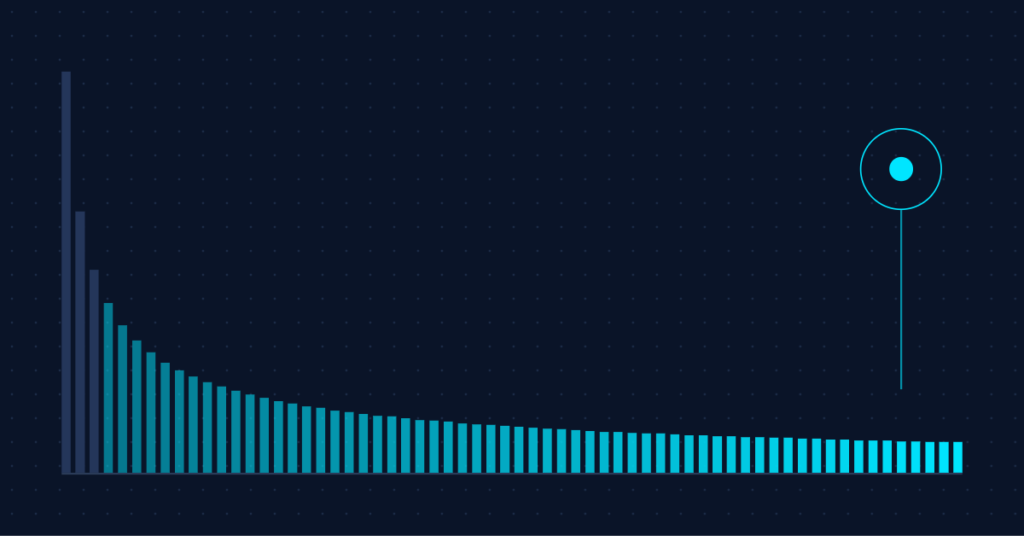
According to Ahrefs, almost 93% of keywords in its US database get fewer than 10 searches a month. Only about 17,700 US keywords get more than 100,000. Big brands chase the few thousand big terms. The billions of specific questions are left open.
Google says size alone isn’t the deciding factor
In an October 2024 interview, Google’s Search Liaison Danny Sullivan said: “The core of it isn’t really whether you’re big or you’re small.” He added that Google doesn’t want “only the very big things” to rank well, and advised smaller sites to develop their brand.
Where large companies are weak
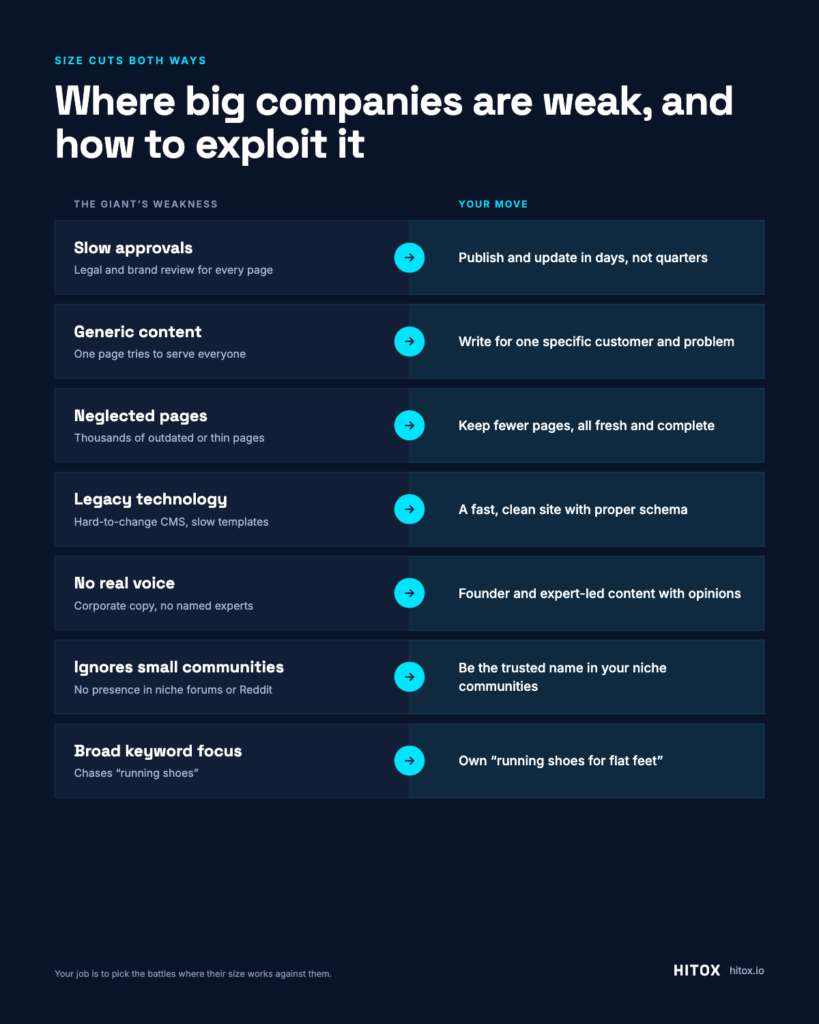
| Big company weakness | What it looks like | How a small brand exploits it |
|---|---|---|
| Slow approvals | Legal and brand review for every page | Publish and update in days, not quarters |
| Generic content | One page tries to serve everyone | Write for one specific customer and problem |
| Neglected pages | Thousands of outdated or thin pages | Keep fewer pages, all fresh and complete |
| Legacy technology | Hard-to-change CMS, slow templates | A fast, clean site with proper schema |
| No real voice | Corporate copy, no named experts | Founder and expert-led content with opinions |
| Ignores small communities | No presence in niche forums or Reddit | Be the trusted name in your niche communities |
| Broad keyword focus | Chases “running shoes” | Owns “running shoes for flat feet” |
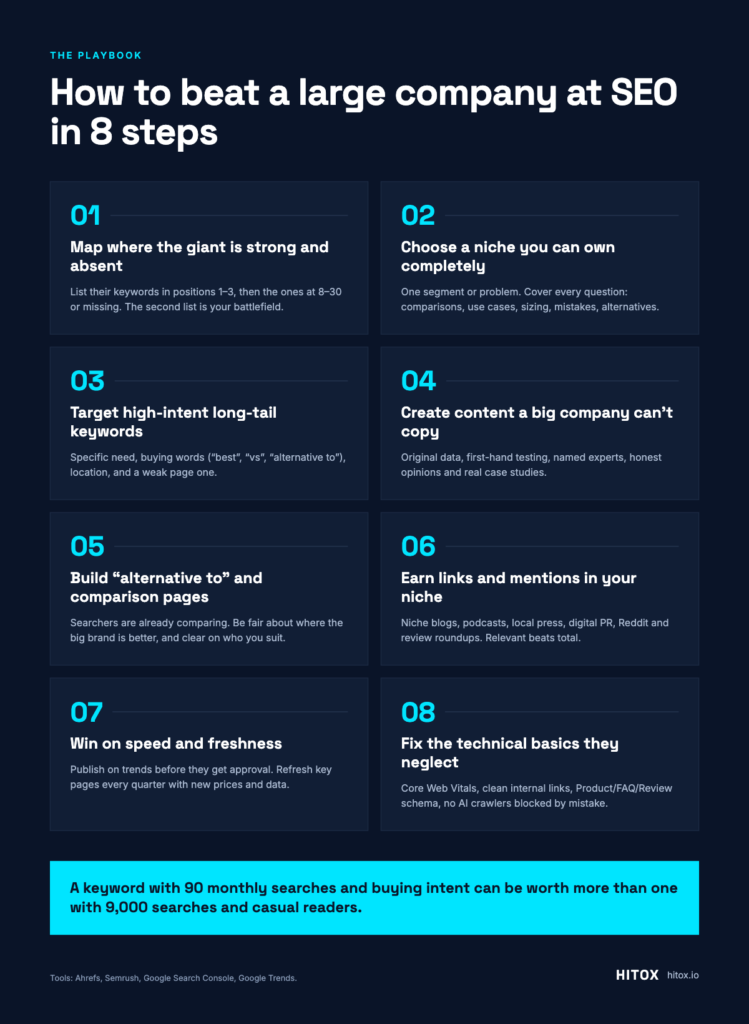
How to beat a large company at SEO: 8 steps
Step 1: Map where the giant is strong and where it is absent
Put your top competitor’s domain into Ahrefs, Semrush or Google Search Console comparisons. List the keywords they rank for in positions 1–3, and the ones where they rank 8–30 or not at all. The second list is your battlefield.
Quick check: search your main buying questions and look at page one. If you see forum threads, thin listicles or outdated pages, the big brand isn’t really serving that query.
Step 2: Choose a niche you can own completely
Don’t spread across 50 topics. Pick one customer segment or problem, such as “running shoes for flat feet” instead of “running shoes”. Then cover every question in it: comparisons, use cases, sizing, mistakes, alternatives.
This is topical authority. A site that answers 60 related questions well often beats a giant that answers one generically.
Step 3: Target high-intent long-tail keywords first
Prioritize keywords with these signals:
- Specific need: “for small teams”, “for beginners”, “for wide feet”
- Buying intent: “best”, “vs”, “alternative to”, “pricing”, “review”
- Location: “near me”, city or region names
- Weak page one: forums, old posts or generic category pages ranking
A keyword with 90 monthly searches and buying intent can be worth more than one with 9,000 searches and casual readers.
Step 4: Create content a big company can’t copy
Large brands produce safe, generic content. Win with what they can’t easily make:
- Original data: surveys, customer data, small studies, price comparisons
- First-hand testing: real photos, videos and results
- Named experts: the founder or specialist as the author, with credentials
- Strong opinions: honest pros and cons, including when your product isn’t the right fit
- Case studies: real numbers from real customers
Step 5: Build “alternative to” and comparison pages
People searching “[Big Brand] alternative” or “[Big Brand] vs [Small Brand]” are already comparing. Write fair, specific comparisons. Be honest about where the big brand is better, and clear about who your product suits better.
Step 6: Earn links and mentions in your niche, not everywhere
You won’t match a giant’s total backlinks, and you don’t need to. Focus on relevant mentions:
- Niche blogs, newsletters and podcasts
- Local press and industry associations
- Digital PR built around your original data from Step 4
- Reddit, Quora and community forums where your customers ask questions (help genuinely; don’t spam)
- Review sites and “best of” roundups in your category
Step 7: Win on speed and freshness
Publish on new trends before big brands get approval. Update your key pages every quarter with new prices, products and data. Use Google Trends and Reddit to spot rising questions early.
Step 8: Fix technical basics they neglect
A fast, clean site is a real advantage over a giant’s legacy platform:
- Fast load times and good Core Web Vitals on mobile
- Clean internal linking between your niche pages
- Product, FAQ, Review and Organization schema
- No AI crawlers blocked by mistake in robots.txt
- One clear page per topic, no duplicates competing with each other
The new opening: beating big brands in AI search
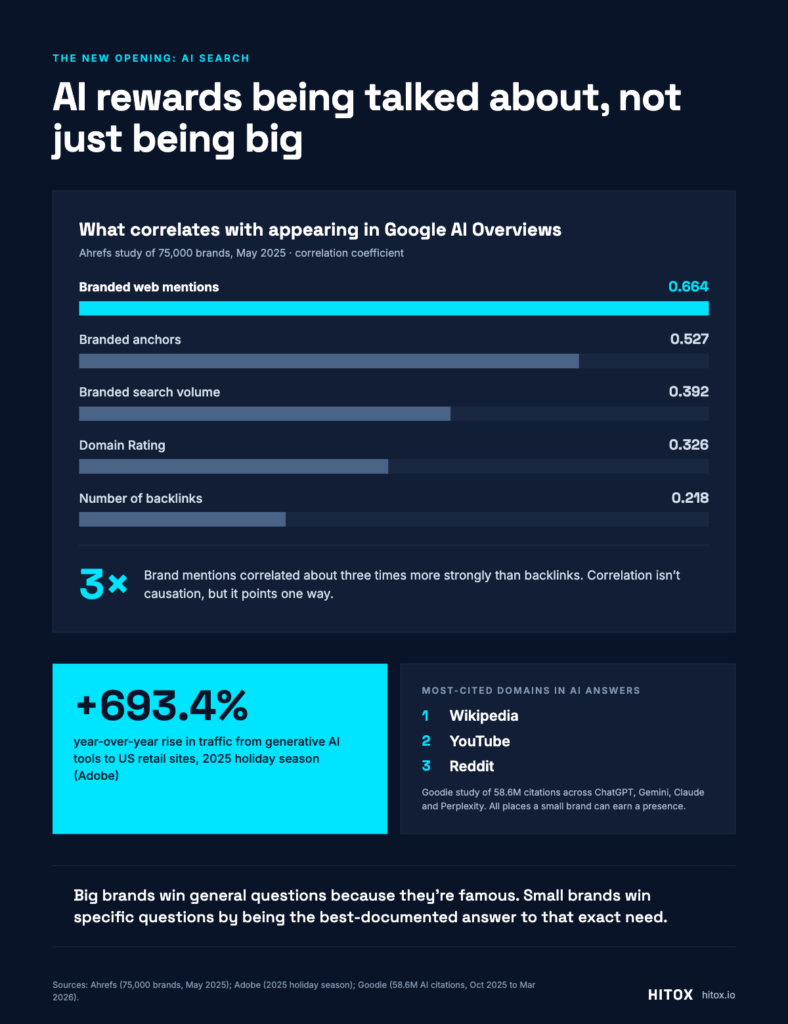
AI search rewards being talked about, not just being big. That is the biggest shift for small brands since Google launched, and most “beat the big guys” guides haven’t covered it yet.
The traffic is real. Adobe reported that traffic from generative AI tools to US retail sites rose 693.4% year over year in the 2025 holiday season.
Mentions matter more than backlinks in AI answers
Ahrefs studied 75,000 brands (May 2025) to see what correlates with appearing in Google’s AI Overviews:
| Factor | Correlation with AI Overview visibility |
|---|---|
| Branded web mentions | 0.664 |
| Branded anchors | 0.527 |
| Branded search volume | 0.392 |
| Domain Rating | 0.326 |
| Number of backlinks | 0.218 |
Brand mentions correlated about three times more strongly than backlinks. As the authors note, correlation isn’t causation. But it points one way: a small brand that is widely discussed in its niche can show up next to giants, even with a fraction of their links.
AI engines lean on communities and reviews
A Goodie study of 58.6 million AI citations (Oct 2025 to Mar 2026) across ChatGPT, Gemini, Claude and Perplexity found Wikipedia, YouTube and Reddit were the three most-cited domains. Review sites such as TechRadar and Tom’s Guide also ranked high. These are places a small brand can earn a presence, without outspending anyone.
The prompt gap: an approach most guides miss
Most advice stops at “get mentioned more”. The sharper move is to find prompt gaps: buying questions where AI recommends the big brand only because nobody has given it a better, more specific answer.
- List 50–100 buying questions in your niche, the way customers ask AI (“best CRM for a 10-person agency that uses Gmail”).
- Ask each one in ChatGPT, Gemini, Perplexity and Google AI Mode, in a fresh, logged-out chat, and record which brands are recommended.
- Note the sources each engine cites for that answer.
- Mark the gaps: questions where the big brand appears with a generic reason (“popular”, “well-known”), or where the cited sources are thin or outdated.
- Fill those gaps with a specific page, a comparison, a Reddit answer, or a mention in the cited review sites.
- Re-run the same questions monthly and track your share of answer.
Big brands win AI answers on general questions because they’re famous. Small brands win specific questions by being the best-documented answer to that exact need.
The lesson is the same as Step 3: a small budget aimed at buyers’ specific questions compounds. A big budget spread across generic keywords often doesn’t.
People also ask
What is the 80/20 rule in SEO?
It’s the idea that roughly 20% of your work or pages drive about 80% of results. For a small brand, that 20% is usually a handful of high-intent pages: core product or service pages, comparison pages and “best for” guides. Improve those before publishing anything new. The 80/20 split is a rule of thumb, not a measured law, so check your own Search Console data to find your top pages.
Is SEO dead now with AI?
No. It is changing. AI tools like Google AI Overviews, ChatGPT and Perplexity still pull answers from web pages, and many cite them with links. The basics still matter: helpful content, crawlable pages, a strong reputation. What has changed is that being mentioned across the web, on Reddit, review sites and in articles, now matters as much as ranking your own pages.
Can ChatGPT do an SEO audit?
Partly. ChatGPT can review content you paste in, suggest title tags and headings, explain technical issues and draft schema. It cannot reliably crawl your whole site, see your real rankings and traffic, or measure backlinks on its own. Use it alongside Google Search Console and a crawler such as Screaming Frog, Ahrefs or Semrush, and check its suggestions before acting.
How do you rank #1 in SEO?
Pick a query where you can realistically be the best answer, then make the page that genuinely is:
- Match the searcher’s intent exactly (a guide, a comparison or a product page)
- Answer the question better and more specifically than the current #1
- Add first-hand proof: data, examples, photos, expert authorship
- Earn a few relevant links and mentions
- Keep the page updated
For a small business, #1 for a specific long-tail query is very achievable. #1 for a broad head term against a giant usually isn’t worth the fight early on.
What this means for your marketing
Beating a big company at SEO isn’t a separate project. It is your positioning, applied to search. The same niche focus should run through your ads, social media, sales calls and partnerships:
- Positioning: the niche you own in search is the customer you describe on your homepage.
- Content marketing: original data from Step 4 becomes LinkedIn posts, PR pitches and newsletter issues.
- Community marketing: helpful Reddit and forum answers build both search mentions and real customers.
- Paid ads: pages that rank for specific queries usually convert paid traffic better too.